Showing posts with label Obama. Show all posts
Showing posts with label Obama. Show all posts
Thursday, January 24, 2013


Wednesday, February 22, 2012
Talk of War: Iran
It may just be another effect of elections season, but there seems to be a ranching up of the rhetoric against Iran (particularly from the GOP). Here are some less political and more pragmatic words from the Secretary of Defense Leon Penetta, one of the primary foreign policy advisers to President Obama.
Video from Al Jazeera's Patty Culhane reports from Washington
Basically calm down people. Do not fear an Armageddon, rather naval retribution.
If Israel attacked Iran in a preemptive strike:
1. It won't work. A strike would delay rather than prevent the development of a nuclear weapon.
2.Empower Iranian Government and make the U.S. a target of Iranian retribution.
American war games result: 16 downed ships (including an aircraft carrier) and 1000s of casualties.

Video from Al Jazeera's Patty Culhane reports from Washington
Basically calm down people. Do not fear an Armageddon, rather naval retribution.
If Israel attacked Iran in a preemptive strike:
1. It won't work. A strike would delay rather than prevent the development of a nuclear weapon.
2.Empower Iranian Government and make the U.S. a target of Iranian retribution.
- American Navy
- Hurt the American and Western European Economies (cutting off oil)
American war games result: 16 downed ships (including an aircraft carrier) and 1000s of casualties.
Wednesday, February 1, 2012
John Kiriakou: American Spy to be Charged under espionage Act
John Kiriakou’s
Path From Ambitious
Spy to Federal Defendant
- NYTimes.com:
Former CIA officer John Kiriakou,
left, and his attorney John Hundley,
leave federal court in Alexandria,
Virginia. Photograph: Jacquelyn Martin/AP
The Witnessing
Of American
Torture
Former CIA Agent Charged Under Espionage Act For Reporting Torture -Buzzfeed
"He's not a "whistleblower." He's a guy who hunted down Al Qaeda in Afghanistan and Pakistan who decided waterboarding was a bad idea and decided to say so.
People already knew waterboarding was going on. He just said it didn't work, pointing out that Abu Zubaydah was talking immediately and didn't need to be waterboarded 83 times.
Pretty embarrassing for the government. So, they found one reporter to say that Kiriakou gave him one name.
Oh. And they fired his wife this week for good measure."
-AdminPassword via Reddit

Sunday, January 8, 2012
Thursday, January 5, 2012
American Military Changing Strategy: Defense Strategic Review
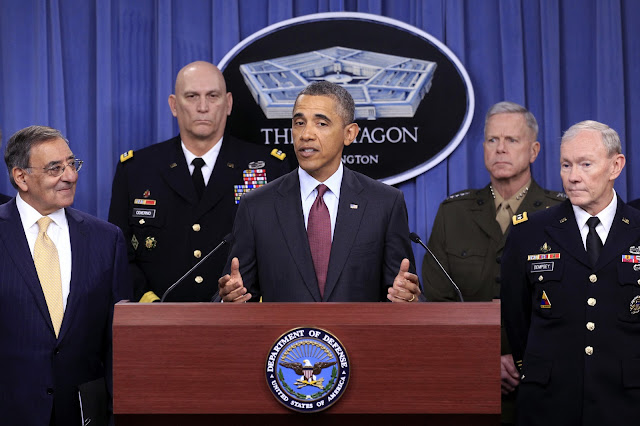
President Obama started off the discussion on forward defensive strategy in the Pentagon today, something unprecedented. This came at a time when our government is looking to reduce costs everywhere.
It seems that while now may have been the time to rethink military strategy anyway (with the withdraw from Iraq and deescalation of Afghanistan) the budget debate has forced this transition to the political forefront.
Obama noted that while the projected military spending will decrease the overall military budget will continue to increase (just at a reduced rate).

"Four Over Arching Principles":
-The United States will expand its allies and partners and will invest in NATO
-Reversibility in Downsizing Ground Forces
There is no question that we have to will have to make some trade offs and that
 Conclusion:
I believe that in many ways that we are at a crises point but that in every crises there is opportunity. Out of this crises we have the opportunity to end the old ways of doing business and to build a modern army for the 21st century that can win today's wars and successfully confront any enemy and respond to any threat and any challenge for the future.

It seems that while now may have been the time to rethink military strategy anyway (with the withdraw from Iraq and deescalation of Afghanistan) the budget debate has forced this transition to the political forefront.
- The Strategy Review has included the President for the first Time
Obama noted that while the projected military spending will decrease the overall military budget will continue to increase (just at a reduced rate).
The new military strategy going forward for the United States includes $478 billion in cuts over the next 10 years and will, in Panetta's words, cause "some level of additional but acceptable risk."
 |
| Leon Panetta, Defense Secretary and former Head of the CIA, followed up the president's somewhat political announcement with more detail. |
- "We must maintain the world's finest military, one that supports and sustains the unique global leadership role of the United States"
- "We must avoid hollowing out the force, a smaller, ready and well equipped military is much more preferable to a larger ill-prepared force that has been arbitrarily cut across the board.
- "Savings must be achieved in a balanced manor, everything must be on the table including politically sensitive areas that will likely provoke opposition from parts of the Congress, from Industry, and from advocacy groups. That is the nature of making hard choices."
- "We must preserve the quality of the all voluntary force, and not break faith in our men and women in uniform or their families.
-The Emphasis will shift to the Broader Middle East and the Pacific
- maintain its capability across the board
- be smaller and it will be leaner but its greater strength is that it will be more flexible, more agile, ready to be deployed more quickly, innovative, and technologically advanced
-The United States will expand its allies and partners and will invest in NATO
- more of a partnership role like that shown in Libya and Latin America
- emphasis on rotational deployments
- requires greater flexibility to quickly deploy anywhere
- how we defeat the enemy will vary across conflicts
- as a global force our military will never just be responsible for one thing
- better use of diplomacy, development, and security force assistance
- The Army and Marine Corps will no longer need to be sized to support the kind of large scale long term stability operations that have dominated military priorities and forces over the past decade
- increase new technologies: like ISR (Intelligence Surveillance and Reconnaissance) and unmanned systems in space and in cyber space as well as the capacity to quickly mobilize if necessary
-Reversibility in Downsizing Ground Forces
- maintaining a healthy National Guard and Reserve
- maintaining experienced cadre of NCOs and mid-grade officers
- maintaining defense industrial base
- different from the Cold War, the post-cold war of the 1990s, and the forces of the last decade that was built to engage in large scale ground wars
"we invest in new capabilities maintain a decisive military edge against a growing array of threats."
"we will be taking on some level of
additional but acceptable risk."
We will consolidate our duplicative operations and will reduce waste. But budgetary reductions of this magnitude will inevitably effect the size and capabilities of our military.
 Conclusion:
I believe that in many ways that we are at a crises point but that in every crises there is opportunity. Out of this crises we have the opportunity to end the old ways of doing business and to build a modern army for the 21st century that can win today's wars and successfully confront any enemy and respond to any threat and any challenge for the future.
Tuesday, October 18, 2011
The United States' Secrets: War Post 9/11
 |
| Frontline's "Top Secret America" |
The Over Seas Contingency Operations, formally the Global War on Terror (G.W.O.T. got a make over back in 2009), has lead to a reshaping of American foreign policy.
Watch Top Secret America on PBS. See more from FRONTLINE.
 |
| "These buildings that─ they might only be four stories high, but they go down ten stories. And there’s a whole world down there, like shops and places to eat, that you don’t know about that’s just for them." MICHAEL WILLIAMSON WITH THE WASHINGTON POST |
 |
| "In a post-9/11 world, we weren’t going to be so prissy." -HOMELAND SECURITY ADVISER FRAN TOWNSEND |


Wednesday, October 12, 2011
Voting: Suspicions of Computer voting machines become Grounded

- The code may be inserted remotely
- can tamper tens of thousands of votes discretely
- The code can be programmed to "eat it itself"
The Simpsons are spot on with this one: Homer Simpson Tries to Vote for Obama

Saturday, October 1, 2011
The Killing of al-Awlaki: the American and Al-Qaeda's number two
 |
| And Another One Bites the Dust |
Who was al-Awlaki?
When, if ever, can an American be targeted and killed by American armed forces?
Watch the full episode. See more PBS NewsHour.
Watch the full episode. See more PBS NewsHour.

Friday, September 23, 2011


Tuesday, August 2, 2011


Tuesday, March 29, 2011
Wednesday, October 13, 2010
From the Donkey's Mouth
Before I get too deep into the intricacies of education reform I suggest to my loyal readers to watch Obama’s speech to the Urban League. It is a long video (for this reason I suggest jumping to 12:00 we must remember Obama is still a politician and is very long winded), but it is a chance to see and hear the Obama’s administration’s reasoning for education reform from an unfiltered source.
America's Latest go at Education Reform: Arne Duncan and the Race to the Top


American Reading: 12th and 23rd out of 40 nations.
American Math: 25th and 28th out of 40 nations.
American Science: 20th and 27th out of 40 nations.
Even without knowing these exact figures it easy to see that students in America, called “our future” by politicians on both sides of the aisle, have fallen behind. As Obama points out in his address to the Urban League, to the same thing repeatedly over and over and to expect a different result in the definition of madness. Clearly there needs to be a rethinking of the American education system. Like healthcare (which again will be discussed at length in an upcoming article), the education system has long been known to need such reform. The question of how to reform the educational system, both in method and in direction has caused the American education system as a stagnant.
The barriers to education are indeed rather intimidating. For starters there are the teachers’ unions. For some reason the teacher’s unions have remained while in all other occupations the organizational structure seems to have disappeared almost entirely. The reason behind the disappearance of the Unions is largely attributed to their lack of need. In most fields employees now see handling personal issues such as pay and time off at the personal level rather than leaving it up to a representatives as not only desirable but the “natural” way of conducting business. To go into further detail of the pros and cons of unions is a discussion for another day, but for now I think it would be fair to say that the union increasingly seen as inefficient by those unfavorable to them, and cumbersome or powerless for those within the unions. Teachers Unions have been a key voting block for Democrats and for this reason it has been difficult to enact aggressive reforms.

Arne Duncan is graying intelligent with a sideways grin. He has controversial ideas about education including initiating merit based pay for teachers in return for more accountability and supports charter schools in a number of educational scenarios. This is a man known to win national three-on-three street basketball tournaments on the weekends, has played professional basketball in Australia and graduated Magna Cum Lade from Harvard University. All and all Mr. Duncan is successful and continues this success in the program entitled Race to the Top.
Race to the Top was a slice of the Recovery Act and is financed with an initial sum of 4.5 billion dollars and is the principal source of education reform in the Obama administration’s arsenal in education reform. This kind of money is unheard of and gives real heft to the Secretary of Education to make a real and lasting difference in how education will be conducted in the years to come. This kind of money is enough to make Solomon blush but it seems Arne Duncan is putting the money to good use. Critics and proponents alike have deemed the Race to the Top structure of grants as innovative and wildly successful and some even believe it will become the ideal of doing business between the federal government is a number of areas even beyond that of education. Evidence of this can be shown in the upcoming health care debate (yes States have yet to determine who will get what and how any money granted by the federal government will be spend) and in addition according to the Department of Education’s website the Race to the Top program has recently been given an additional 1.35 billion dollars by Congress.
The Race to the Top program’s success, from the federal government’s perspective, is in that it has caused massive reforms of many states (40 participated in the first round) even before the first dime of federal monies was issued. The reason being, unlike past grants, states must compete amongst one another in addition to amassing a set number of “points.” The competition not only encourages reforms beyond that which is asked in some cases but also accelerates the speeds of such reforms. Points are awarded on the basis of school systems completion of certain educational goals, which are set by the Secretary of Education. Instead of saying each school district must do this particular reform, the point system allows greater flexibility to the school districts. This allows areas to improve on what is needed most as well as those which they are most capable of improving (a smart way of upholding the State’s traditional independent control over education while simultaneously pushing for necessary reforms). What these goals and points entail will be discussed later. The number of points needed set knowingly high. For this reason in the first round of The Race to the Top program only nine states in addition to the District of Columbia were able to qualify. As Obama has said in his speech to the Urban League in July, setting a high bar actually encourages more reform, not less, even by those states which were successful in the first round.
 The president pointed this out in that 38 states competed in the second round, including all those which had succeeded in the first. To set the bar high for states by the federal government seems to be in stark contrast with that of the previous educational reform effort, No Child Left Behind. While No Child Left Behind is now seen as asking much from the states, but not giving them any financial means of following through, Race to the Top clearly does the opposite with its multi-billion dollar purse. Comparing No Child left behind with Race to the Top also helps define the later program. While Bush’s program gave incentives to states to lower the difficulty of standardized testing, thereby allowing them to get a higher “grade,” Obama’s program seems to do the opposite. To paraphrase Obama, Race to the Top prevents graduates from receiving their diplomas and then not being able to read it.
It seems Race to the Top also directly addresses No Child Left Behind’s shortcoming because while Race to the Top Brings in outside resources to failing schools, even to the point of flipping school of all faculty and staff and turning it into a charter school (in the most desperate situations to allow more flexibility), No Child Left Behind simply labeled the school as failing. Another improvement on the previous program is that Race to the Top uses a wide variety of techniques to determine whether a school is “failing.” In addition to student testing, which has increased in difficulty and diversity so that supposedly there is less “teaching to the test,” Duncan’s program uses data collected from teachers, principals, and the community to better assess the real state of a school’s health. For this reason Race to the Top also has an emphasis on collecting a larger variety of data in order to gage student success. The program also sets aside statiticians and logistics specialists to help gather a deeper understanding of what is really happening in the classroom. Points are awarded to states which take up such reforms as these (inkling data collection and increased difficulty and variety in standardized testing).
All of these things help States and parents better understand what is currently happening in the classroom so effective reforms can take place, but the most important aspect of the classroom is that of the teacher. Teachers are incredibly important to student’s success. Teaching unfortunately is described by many would be teachers as “a nice thing to do but I cannot afford it.” Race to the Top tries to combat innovative and intelligent people from not choosing teaching as a career by introducing the concept of teachers’ merit pay. Like almost all other job fields in the world teachers would now be paid on a number of factors such as student performance, qualifications, and ability. Obama’s administration hopes this will be seen as an incentive to enter the field for prospective teachers. The vast majorities of teachers are beyond hardworking and should be rewarded as such. Now it is true that some underperforming teachers may get the bad end of the deal with lower pay and even removal (Race to the Top will eliminate Tenure). But it makes sense to treat teaching as the professional occupation it is and fire those incapable of doing a decent job. As Arne Duncan says, “kids only get one chance at a good education.”

Subscribe to:
Posts (Atom)