Showing posts with label United States. Show all posts
Showing posts with label United States. Show all posts
Thursday, January 24, 2013


Sunday, March 4, 2012


Saturday, March 3, 2012
Electronic Voting Doesn't Work

Read the Article: PC World
More on Voting From MountainPassIKnow:

From the Horse's Mouth

PRESIDENT BARACK OBAMA: First of all, it's important to say that I don't know exactly what the prime minister is going to be coming with. We haven't gotten any indication that there is some sharp "ask" that is going to be presented. Both the United States and Israel have been in constant consultation about a very difficult issue, and that is the prospect of Iran obtaining a nuclear weapon. This is something that has been one of my top five foreign-policy concerns since I came into office.
We, immediately upon taking over, mapped out a strategy that said we are going to mobilize the international community around this issue and isolate Iran to send a clear message to them that there is a path they can follow that allows them to rejoin the community of nations, but if they refused to follow that path, that there would be an escalating series of consequences.
Three years later, we can look back and say we have been successful beyond most people's expectations. When we came in, Iran was united and on the move, and the world was divided about how to address this issue. Today, the world is as united as we've ever seen it around the need for Iran to take a different path on its nuclear program, and Iran is isolated and feeling the severe effects of the multiple sanctions that have been placed on it.
At the same time, we understand that the bottom line is: Does the problem get solved? And I think that Israel, understandably, has a profound interest not just in good intentions but in actual results. And in the conversations I've had over the course of three years, and over the course of the last three months and three weeks, what I've emphasized is that preventing Iran from getting a nuclear weapon isn't just in the interest of Israel, it is profoundly in the security interests of the United States, and that when I say we're not taking any option off the table, we mean it. We are going to continue to apply pressure until Iran takes a different course.
GOLDBERG: Go back to this language, 'All options on the table.' You've probably said it 50 or 100 times. And a lot of people believe it, but the two main intended audiences, the supreme leader of Iran and the prime minister of Israel, you could argue, don't entirely trust this. The impression we get is that the Israeli government thinks this is a vague expression that's been used for so many years. Is there some ramping-up of the rhetoric you're going to give them?

PRESIDENT OBAMA: I think the Israeli people understand it, I think the American people understand it, and I think the Iranians understand it. It means a political component that involves isolating Iran; it means an economic component that involves unprecedented and crippling sanctions; it means a diplomatic component in which we have been able to strengthen the coalition that presents Iran with various options through the P-5 plus 1 and ensures that the IAEA [International Atomic Energy Agency] is robust in evaluating Iran's military program; and it includes a military component. And I think people understand that.
I think that the Israeli government recognizes that, as president of the United States, I don't bluff. I also don't, as a matter of sound policy, go around advertising exactly what our intentions are. But I think both the Iranian and the Israeli governments recognize that when the United States says it is unacceptable for Iran to have a nuclear weapon, we mean what we say. Let me describe very specifically why this is important to us.
In addition to the profound threat that it poses to Israel, one of our strongest allies in the world; in addition to the outrageous language that has been directed toward Israel by the leaders of the Iranian government -- if Iran gets a nuclear weapon, this would run completely contrary to my policies of nonproliferation. The risks of an Iranian nuclear weapon falling into the hands of terrorist organizations are profound. It is almost certain that other players in the region would feel it necessary to get their own nuclear weapons. So now you have the prospect of a nuclear arms race in the most volatile region in the world, one that is rife with unstable governments and sectarian tensions. And it would also provide Iran the additional capability to sponsor and protect its proxies in carrying out terrorist attacks, because they are less fearful of retaliation.
GOLDBERG: What would your position be if Israel weren't in this picture?
PRESIDENT OBAMA: It would still be a profound national-security interest of the United States to prevent Iran from getting a nuclear weapon.
GOLDBERG: Why, then, is this issue so often seen as binary, always defined as Israel versus Iran?
"Why is it that despite me never failing to support Israel on every single problem that they've had over the last three years, that there are still questions about that?"PRESIDENT OBAMA: I think it has to do with a legitimate concern on the part of Israel that they are a small country in a tough neighborhood, and as a consequence, even though the U.S. and Israel very much share assessments of how quickly Iran could obtain breakout capacity, and even though there is constant consultation and intelligence coordination around that question, Israel feels more vulnerable. And I think the prime minister and the defense minister, [Ehud Barak,] feel a profound, historic obligation not to put Israel in a position where it cannot act decisively and unilaterally to protect the state of Israel. I understand those concerns, and as a consequence, I think it's not surprising that the way it gets framed, at least in this country, where the vast majority of people are profoundly sympathetic to Israel's plight and potential vulnerabilities -- that articles and stories get framed in terms of Israel's potential vulnerability.
But I want to make clear that when we travel around the world and make presentations about this issue, that's not how we frame it. We frame it as: this is something in the national-security interests of the United States and in the interests of the world community. And I assure you that Europe would not have gone forward with sanctions on Iranian oil imports -- which are very difficult for them to carry out, because they get a lot of oil from Iran -- had it not been for their understanding that it is in the world's interest, to prevent Iran from getting a nuclear weapon. China would not have abided by the existing sanctions coming out of the National Security Council, and other countries around the world would not have unified around those sanctions, had it not been for us making the presentation about why this was important for everyone, not just one country.
GOLDBERG: Is it possible that the prime minister of Israel has over-learned the lessons of the Holocaust?
Thursday, February 23, 2012
The Old and the New: Casting Your Vote
Watch America at the Ballot Box: Technology Through the Years on PBS. See more from PBS NewsHour.
Wednesday, February 22, 2012
Talk of War: Iran
It may just be another effect of elections season, but there seems to be a ranching up of the rhetoric against Iran (particularly from the GOP). Here are some less political and more pragmatic words from the Secretary of Defense Leon Penetta, one of the primary foreign policy advisers to President Obama.
Video from Al Jazeera's Patty Culhane reports from Washington
Basically calm down people. Do not fear an Armageddon, rather naval retribution.
If Israel attacked Iran in a preemptive strike:
1. It won't work. A strike would delay rather than prevent the development of a nuclear weapon.
2.Empower Iranian Government and make the U.S. a target of Iranian retribution.
American war games result: 16 downed ships (including an aircraft carrier) and 1000s of casualties.

Video from Al Jazeera's Patty Culhane reports from Washington
Basically calm down people. Do not fear an Armageddon, rather naval retribution.
If Israel attacked Iran in a preemptive strike:
1. It won't work. A strike would delay rather than prevent the development of a nuclear weapon.
2.Empower Iranian Government and make the U.S. a target of Iranian retribution.
- American Navy
- Hurt the American and Western European Economies (cutting off oil)
American war games result: 16 downed ships (including an aircraft carrier) and 1000s of casualties.
Wednesday, February 1, 2012


Thursday, January 19, 2012

Saturday, January 14, 2012
Sunday, January 8, 2012
American Military: Cutting Increases in Spending
The American Government is in the process of trying to cut $450 billion in spending.
How much and what programs would you cut?
Good news the N.Y. Times is here to help with this interactive article
 |
| The Future Military: Your Budget Strategy |

Thursday, January 5, 2012
American Military Changing Strategy: Defense Strategic Review
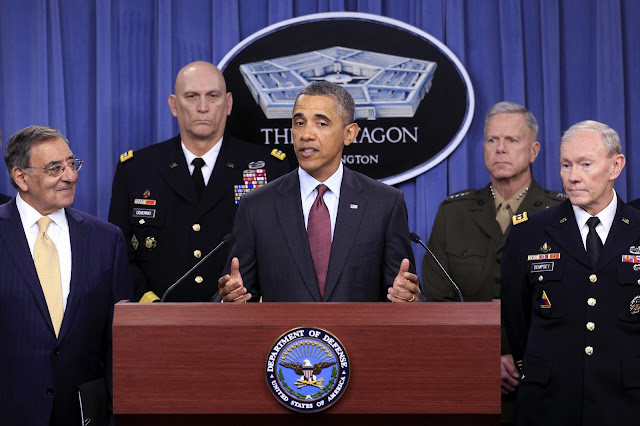
President Obama started off the discussion on forward defensive strategy in the Pentagon today, something unprecedented. This came at a time when our government is looking to reduce costs everywhere.
It seems that while now may have been the time to rethink military strategy anyway (with the withdraw from Iraq and deescalation of Afghanistan) the budget debate has forced this transition to the political forefront.
Obama noted that while the projected military spending will decrease the overall military budget will continue to increase (just at a reduced rate).

"Four Over Arching Principles":
-The United States will expand its allies and partners and will invest in NATO
-Reversibility in Downsizing Ground Forces
There is no question that we have to will have to make some trade offs and that
 Conclusion:
I believe that in many ways that we are at a crises point but that in every crises there is opportunity. Out of this crises we have the opportunity to end the old ways of doing business and to build a modern army for the 21st century that can win today's wars and successfully confront any enemy and respond to any threat and any challenge for the future.

It seems that while now may have been the time to rethink military strategy anyway (with the withdraw from Iraq and deescalation of Afghanistan) the budget debate has forced this transition to the political forefront.
- The Strategy Review has included the President for the first Time
Obama noted that while the projected military spending will decrease the overall military budget will continue to increase (just at a reduced rate).
The new military strategy going forward for the United States includes $478 billion in cuts over the next 10 years and will, in Panetta's words, cause "some level of additional but acceptable risk."
 |
| Leon Panetta, Defense Secretary and former Head of the CIA, followed up the president's somewhat political announcement with more detail. |
- "We must maintain the world's finest military, one that supports and sustains the unique global leadership role of the United States"
- "We must avoid hollowing out the force, a smaller, ready and well equipped military is much more preferable to a larger ill-prepared force that has been arbitrarily cut across the board.
- "Savings must be achieved in a balanced manor, everything must be on the table including politically sensitive areas that will likely provoke opposition from parts of the Congress, from Industry, and from advocacy groups. That is the nature of making hard choices."
- "We must preserve the quality of the all voluntary force, and not break faith in our men and women in uniform or their families.
-The Emphasis will shift to the Broader Middle East and the Pacific
- maintain its capability across the board
- be smaller and it will be leaner but its greater strength is that it will be more flexible, more agile, ready to be deployed more quickly, innovative, and technologically advanced
-The United States will expand its allies and partners and will invest in NATO
- more of a partnership role like that shown in Libya and Latin America
- emphasis on rotational deployments
- requires greater flexibility to quickly deploy anywhere
- how we defeat the enemy will vary across conflicts
- as a global force our military will never just be responsible for one thing
- better use of diplomacy, development, and security force assistance
- The Army and Marine Corps will no longer need to be sized to support the kind of large scale long term stability operations that have dominated military priorities and forces over the past decade
- increase new technologies: like ISR (Intelligence Surveillance and Reconnaissance) and unmanned systems in space and in cyber space as well as the capacity to quickly mobilize if necessary
-Reversibility in Downsizing Ground Forces
- maintaining a healthy National Guard and Reserve
- maintaining experienced cadre of NCOs and mid-grade officers
- maintaining defense industrial base
- different from the Cold War, the post-cold war of the 1990s, and the forces of the last decade that was built to engage in large scale ground wars
"we invest in new capabilities maintain a decisive military edge against a growing array of threats."
"we will be taking on some level of
additional but acceptable risk."
We will consolidate our duplicative operations and will reduce waste. But budgetary reductions of this magnitude will inevitably effect the size and capabilities of our military.
 Conclusion:
I believe that in many ways that we are at a crises point but that in every crises there is opportunity. Out of this crises we have the opportunity to end the old ways of doing business and to build a modern army for the 21st century that can win today's wars and successfully confront any enemy and respond to any threat and any challenge for the future.
Tuesday, December 13, 2011


Tuesday, December 6, 2011
Anwar al-Awlaki: Solidifying the Power of the Presidency to Kill Americans
I hope to return to this soon.
If you don't know who al-Awlaki is please look at my previous posts
Who was Al Qaeda's Number 2
The Killing of Al-Awlaki 2
But as the National Defense Authorization Act of 2012 is not yet fully complete I will not comment on the issue.
MSNBC's Take

If you don't know who al-Awlaki is please look at my previous posts
Who was Al Qaeda's Number 2
The Killing of Al-Awlaki 2
But as the National Defense Authorization Act of 2012 is not yet fully complete I will not comment on the issue.
But for Now here is a highly slanted opinion from Anonymous
MSNBC's Take
Wednesday, November 30, 2011
Thank You For Your Service: Connotations
NPR: Here and Now
What do you say when you see a soldier in uniform, in an airport, say, or another public place?
Well, it might surprise you to know that some members of the military are uncomfortable with the phrase “thank you for your service."
What do you say when you see a soldier in uniform, in an airport, say, or another public place?
Well, it might surprise you to know that some members of the military are uncomfortable with the phrase “thank you for your service."
Tuesday, November 29, 2011
A Hot Flash in the Cold War With Pakistan (updated)
An United States Airstrike Kills 24 Pakistani Soldiers:
Pakistan Gaves US the OK for Airstrike (update)
 Pakistan Reacts by closing much needed borders to NATO military.
Read the article from the Atlantic.

Pakistan Gaves US the OK for Airstrike (update)

Read the article from the Atlantic.
Friday, November 4, 2011
Game Theory and Cyber Attacks lead to Military Conflict: TED
Good afternoon. If you have followed diplomatic
news in the past weeks, you may have heard of a kind of crisis between China
and the U.S.regarding cyberattacks against the American company Google. Many
things have been said about this. Some people have called a cyberwarwhat may
actually be just a spy operation -- and obviously, a quite mishandled one.
However, this episode reveals the growing anxiety in the Western world
regarding these emerging cyber weapons.

It so happens that these weapons are
dangerous.They're of a new nature: they could lead the worldinto a digital
conflict that could turn into an armed struggle. These virtual weapons can also
destroy the physical world. In 1982, in the middle of the Cold War in Soviet
Siberia, a pipeline exploded with a burst of 3 kilotons, the equivalent of a
fourth of the Hiroshima bomb. Now we know today -- this was revealed by Thomas
Reed, Ronald Reagan's former U.S. Air Force Secretary -- this explosion was
actually the result of a CIA sabotage operation, in which they had managed to
infiltrate the IT management systems of that pipeline.
More recently, the U.S. government revealed that
in September 2008, more than 3 million people in the state of Espirito Santo in
Brazil were plunged into darkness, victims of a blackmail operation from cyber
pirates. Even more worrying for the Americans, in December 2008 the holiest of
holies, the IT systems of CENTCOM, the central command managing the wars in
Iraq and Afghanistan, may have been infiltrated by hackerswho used these: plain
but infected USB keys. And with these keys, they may have been able to get
inside CENTCOM's systems, to see and hear everything, and maybe even infect
some of them.As a result, the Americans take the threat very seriously. I'll
quote General James Cartwright,Vice Chairman of the Joint Chiefs of Staff, who
says in a report to Congress that cyberattacks could be as powerful as weapons
of mass destruction. Moreover, the Americans have decided to spend over 30
billion dollars in the next five years to build up their cyberwar capabilities.
And across the world today, we see a sort of
cyber arms race, with cyberwar units built up by countries like North Korea or
even Iran. Yet, what you'll never hear from spokespeople from the Pentagon or
the French Department of Defence is that the question isn't really who's the enemy,
but actually the very nature of cyber weapons. And to understand why, we must
look at how, through the ages, military technologies have maintained or
destroyed world peace. For example, if we'd had TEDxParis 350 years ago, we
would have talked about the military innovation of the day -- the massive
Vauban-style fortifications -- and we could have predicted a period of
stability in the world or in Europe. which was indeed the case in Europe
between 1650 and 1750.
Engineers and Bomb Makers: TED
Master storyteller Malcolm Gladwell tells the tale of the Norden bombsight, a groundbreaking piece of World War II technology with a deeply unexpected result.
Thank you. It's a real pleasure to be here. I
last did a TEDTalk I think about seven years ago or so. I talked about
spaghetti sauce. And so many people, I guess, watch those videos. People have
been coming up to me ever since to ask me questions about spaghetti sauce,
which is a wonderful thing in the short term -- (Laughter) but it's proven to
be less than ideal over seven years. And so I though I would come and try and
put spaghetti sauce behind me.
The theme of this morning's session is Things We
Make. And so I thought I would tell a story about someone who made one of the
most precious objects of his era. And the man's name is Carl Norden. Carl
Norden was born in 1880. And he was Swiss. And of course, the Swiss can be
divided into two general categories: those who make small, exquisite, expensive
objects and those who handle the money of those who buy small, exquisite,
expensive objects. And Carl Norden is very firmly in the former camp. He's an
engineer. He goes to the Federal Polytech in Zurich. In fact, one of his
classmates is a young man named Lenin who would go on to break small,
expensive, exquisite objects.
And he's a Swiss engineer, Carl. And I mean that
in its fullest sense of the word. He wears three-piece suits; and he has a very,
very small, important mustache; and he is domineering and narcissistic and
driven and has an extraordinary ego; and he works 16-hour days; and he has very
strong feelings about alternating current; and he feels like a suntan is a sign
of moral weakness; and he drinks lots of coffee; and he does his best work
sitting in his mother's kitchen in Zurich for hours in complete silence with
nothing but a slide rule.
Tuesday, October 18, 2011
The United States' Secrets: War Post 9/11
 |
| Frontline's "Top Secret America" |
The Over Seas Contingency Operations, formally the Global War on Terror (G.W.O.T. got a make over back in 2009), has lead to a reshaping of American foreign policy.
Watch Top Secret America on PBS. See more from FRONTLINE.
 |
| "These buildings that─ they might only be four stories high, but they go down ten stories. And there’s a whole world down there, like shops and places to eat, that you don’t know about that’s just for them." MICHAEL WILLIAMSON WITH THE WASHINGTON POST |
 |
| "In a post-9/11 world, we weren’t going to be so prissy." -HOMELAND SECURITY ADVISER FRAN TOWNSEND |


Subscribe to:
Posts (Atom)