Thursday, January 19, 2012


Wednesday, January 18, 2012
Scottish Independence
Scotland may be having a referendum for independence from the United Kingdom.
This is a slice of perspective with a side of Old World's sobering wit.

This is a slice of perspective with a side of Old World's sobering wit.
Saturday, January 14, 2012
Sunday, January 8, 2012
American Military: Cutting Increases in Spending
The American Government is in the process of trying to cut $450 billion in spending.
How much and what programs would you cut?
Good news the N.Y. Times is here to help with this interactive article
 |
| The Future Military: Your Budget Strategy |

Thursday, January 5, 2012
American Military Changing Strategy: Defense Strategic Review
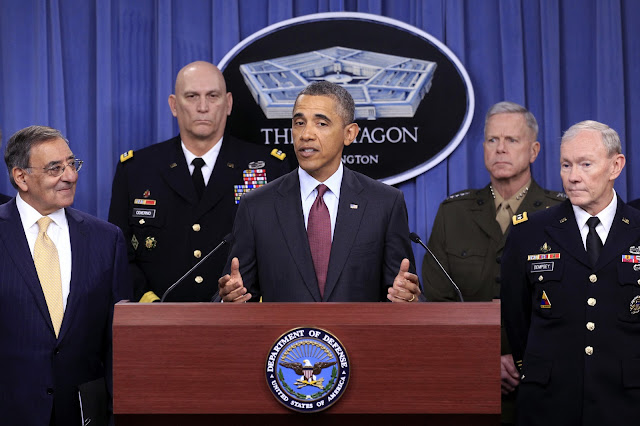
President Obama started off the discussion on forward defensive strategy in the Pentagon today, something unprecedented. This came at a time when our government is looking to reduce costs everywhere.
It seems that while now may have been the time to rethink military strategy anyway (with the withdraw from Iraq and deescalation of Afghanistan) the budget debate has forced this transition to the political forefront.
Obama noted that while the projected military spending will decrease the overall military budget will continue to increase (just at a reduced rate).

"Four Over Arching Principles":
-The United States will expand its allies and partners and will invest in NATO
-Reversibility in Downsizing Ground Forces
There is no question that we have to will have to make some trade offs and that
 Conclusion:
I believe that in many ways that we are at a crises point but that in every crises there is opportunity. Out of this crises we have the opportunity to end the old ways of doing business and to build a modern army for the 21st century that can win today's wars and successfully confront any enemy and respond to any threat and any challenge for the future.

It seems that while now may have been the time to rethink military strategy anyway (with the withdraw from Iraq and deescalation of Afghanistan) the budget debate has forced this transition to the political forefront.
- The Strategy Review has included the President for the first Time
Obama noted that while the projected military spending will decrease the overall military budget will continue to increase (just at a reduced rate).
The new military strategy going forward for the United States includes $478 billion in cuts over the next 10 years and will, in Panetta's words, cause "some level of additional but acceptable risk."
 |
| Leon Panetta, Defense Secretary and former Head of the CIA, followed up the president's somewhat political announcement with more detail. |
- "We must maintain the world's finest military, one that supports and sustains the unique global leadership role of the United States"
- "We must avoid hollowing out the force, a smaller, ready and well equipped military is much more preferable to a larger ill-prepared force that has been arbitrarily cut across the board.
- "Savings must be achieved in a balanced manor, everything must be on the table including politically sensitive areas that will likely provoke opposition from parts of the Congress, from Industry, and from advocacy groups. That is the nature of making hard choices."
- "We must preserve the quality of the all voluntary force, and not break faith in our men and women in uniform or their families.
-The Emphasis will shift to the Broader Middle East and the Pacific
- maintain its capability across the board
- be smaller and it will be leaner but its greater strength is that it will be more flexible, more agile, ready to be deployed more quickly, innovative, and technologically advanced
-The United States will expand its allies and partners and will invest in NATO
- more of a partnership role like that shown in Libya and Latin America
- emphasis on rotational deployments
- requires greater flexibility to quickly deploy anywhere
- how we defeat the enemy will vary across conflicts
- as a global force our military will never just be responsible for one thing
- better use of diplomacy, development, and security force assistance
- The Army and Marine Corps will no longer need to be sized to support the kind of large scale long term stability operations that have dominated military priorities and forces over the past decade
- increase new technologies: like ISR (Intelligence Surveillance and Reconnaissance) and unmanned systems in space and in cyber space as well as the capacity to quickly mobilize if necessary
-Reversibility in Downsizing Ground Forces
- maintaining a healthy National Guard and Reserve
- maintaining experienced cadre of NCOs and mid-grade officers
- maintaining defense industrial base
- different from the Cold War, the post-cold war of the 1990s, and the forces of the last decade that was built to engage in large scale ground wars
"we invest in new capabilities maintain a decisive military edge against a growing array of threats."
"we will be taking on some level of
additional but acceptable risk."
We will consolidate our duplicative operations and will reduce waste. But budgetary reductions of this magnitude will inevitably effect the size and capabilities of our military.
 Conclusion:
I believe that in many ways that we are at a crises point but that in every crises there is opportunity. Out of this crises we have the opportunity to end the old ways of doing business and to build a modern army for the 21st century that can win today's wars and successfully confront any enemy and respond to any threat and any challenge for the future.
Tuesday, December 13, 2011


Tuesday, December 6, 2011
Anwar al-Awlaki: Solidifying the Power of the Presidency to Kill Americans
I hope to return to this soon.
If you don't know who al-Awlaki is please look at my previous posts
Who was Al Qaeda's Number 2
The Killing of Al-Awlaki 2
But as the National Defense Authorization Act of 2012 is not yet fully complete I will not comment on the issue.
MSNBC's Take

If you don't know who al-Awlaki is please look at my previous posts
Who was Al Qaeda's Number 2
The Killing of Al-Awlaki 2
But as the National Defense Authorization Act of 2012 is not yet fully complete I will not comment on the issue.
But for Now here is a highly slanted opinion from Anonymous
MSNBC's Take
Thursday, December 1, 2011
Wednesday, November 30, 2011
Thank You For Your Service: Connotations
NPR: Here and Now
What do you say when you see a soldier in uniform, in an airport, say, or another public place?
Well, it might surprise you to know that some members of the military are uncomfortable with the phrase “thank you for your service."
What do you say when you see a soldier in uniform, in an airport, say, or another public place?
Well, it might surprise you to know that some members of the military are uncomfortable with the phrase “thank you for your service."
Tuesday, November 29, 2011
A Hot Flash in the Cold War With Pakistan (updated)
An United States Airstrike Kills 24 Pakistani Soldiers:
Pakistan Gaves US the OK for Airstrike (update)
 Pakistan Reacts by closing much needed borders to NATO military.
Read the article from the Atlantic.

Pakistan Gaves US the OK for Airstrike (update)

Read the article from the Atlantic.
Barney Frank Steps Down
Representative of Massachusetts, Barney Frank announces that he will not be seeking reelection. He cited political polarization and redistricting as key reasons for not running. Congressman Frank is 71.

This historic piece of legislation has been one of the Republican's go to assaults on Obama and the Democratic Incumbents. Perhaps this is because most people don't know what it is.
It is actually one of the biggest financial regulation reforms since the Great Depression and was enacted in 2007 to provide the federal government with more oversight over private industry.
Quote:
"If you read the journals about [Fank-Dobbs] you will hear people complaining because they say, 'we can't do much.' But I think what we did was to restrict some of the activity that added nothing to the real economy. They were just trading paper back and forth.
I mean these people were engaged in economic transactions which had enough relation to the real economy as much as fantasy football has to Sunday afternoon,
except they were making money of it."- Frank Dobbs on MSNBC's Hardball 12 October 2011
He was also the first openly gay Congressman to serve.
Here Frank discusses the "Radical Homosexual Agenda."

Frank-Dobbs Act.
It is actually one of the biggest financial regulation reforms since the Great Depression and was enacted in 2007 to provide the federal government with more oversight over private industry.
Quote:
"If you read the journals about [Fank-Dobbs] you will hear people complaining because they say, 'we can't do much.' But I think what we did was to restrict some of the activity that added nothing to the real economy. They were just trading paper back and forth.
I mean these people were engaged in economic transactions which had enough relation to the real economy as much as fantasy football has to Sunday afternoon,
except they were making money of it."- Frank Dobbs on MSNBC's Hardball 12 October 2011
He was also the first openly gay Congressman to serve.
Here Frank discusses the "Radical Homosexual Agenda."
Monday, November 21, 2011
Occupy Wall Street: The Fear of Shame
 This make me beyond angry but I put this aside. What was the purpose of this? Was it to clear the walkway? Surely not as evidenced by the police officer who steps over them to take better aim at the protesters. Was the purpose a decision made by the powers that be that the Occupy Wall Street protests have gone on for too long? Was it out of boredom?
The Atlantic Magazine, through a quotation of George Orwell puts it that the police officer pepper sprayed the protester not because he wanted to do so, but because he feared what other would think if he backed down. Having realized it would be a nightmare to shoot students to the sounds of chants of "don't shoot students" electing to pepper spray, to the officer at least, was an attempt to retain dignity.
A dignity which was certainly lost.

Friday, November 18, 2011

Subscribe to:
Posts (Atom)